
Details
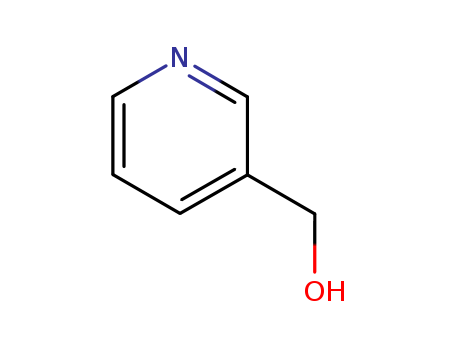
Top Quality Chinese Manufacturer supply 100-55-0 3-Pyridinemethanol
- Molecular Formula: C6H7NO
- Molecular Weight: 109.128
- Appearance/Colour: clear light yellow to yellow liquid
- Vapor Pressure: 0.00442mmHg at 25°C
- Melting Point: -7.7 °C
- Refractive Index: n20/D 1.545(lit.)
- Boiling Point: 266 °C at 760 mmHg
- PKA: 13.68±0.10(Predicted)
- Flash Point: 97.5 °C
- PSA: 33.12000
- Density: 1.124 g/cm3
- LogP: 0.57390
3-Pyridinemethanol(Cas 100-55-0) Usage
|
Manufacturing Process |
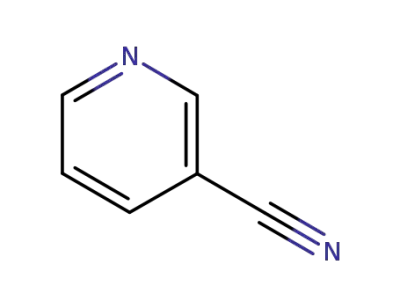
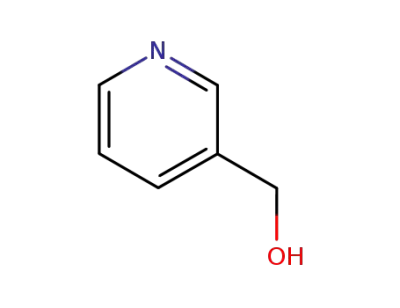
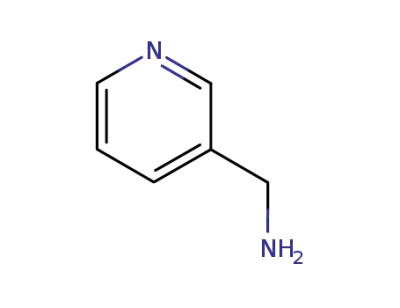
The catalyst is prepared by suspending 5 kg of catalyst grade charcoal in 200 liters of water, in a pressure vessel, and adding thereto 25 liters of 4% (as Pd metal) aqueous palladous chloride. Air is displaced from the vessel and then hydrogen is passed into the aqueous mixture at a pressure of 3 to 5 psi, while stirring, until no further absorption is noted and the chloride is completely reduced to metal.To the aqueous suspension of the palladized charcoal catalyst thus obtained are added 20.8 kg of 3-cyano-pyridine (96% purity); and then are added 70 liters of a hydrochloric acid solution prepared by diluting 30 liters of 36% HCl with 40 liters of water. This represents approximately 1.75 mols of HCl for each mol of 3-cyano-pyridine. The suspension is maintained at 10° to 15°C and stirred continuously while introducing a current of hydrogen at a pressure of 3 to 5 psi. When absorption of hydrogen ceases and the 3-cyanopyridine is completely reduced, the reaction mixture is filtered to remove the catalyst. The filter cake is washed with 40 liters of water in two equal portions, and the wash water is added to the filtrate.The combined liquors, which comprise an aqueous hydrochloric acid solution of 3-aminomethyl-pyridine hydrochloride, are then heated to a temperature of 60° to 65°C, and ethyl nitrite gas is passed into the heated solution. The ethyl nitrite is generated by placing 20 liters of 90% ethyl alcohol in a suitable vessel, diluting with 200 liters of water, and, while stirring, adding to the dilute alcohol 18.3 kg of nitrosyl chloride at the rate of 2.25 kg per hour. (The process using methyl nitrite is carried out by substituting a stoichiometrically equivalent quantity of methyl alcohol for the ethyl alcohol.)When all the ethyl nitrite has been added, the reaction mixture is refluxed for approximately one hour, then concentrated to dryness under reduced pressure (25 to 30 mm Hg) and at a maximum temperature of 70°C. The crystalline residue is dissolved in 35 liters of water and adjusted to a pH of 8 to 9 by addition (with cooling and stirring) of 11 to 12 kg of caustic soda. The sodium chloride formed is filtered off, and the filter cake is washed with 20 liters of normal butyl alcohol. This wash liquid is used for the first extraction of the product from the aqueous filtrate. The filtrate is then further extracted with four successive 20-liter portions of n-butyl alcohol.All the extracts are combined and concentrated in vacuo (100°C/20 mm) to remove the n-butyl alcohol. The residue is submitted to fractionation under reduced pressure. The forerun (up to 112°C/2 to 3 mm) consists of a small amount of n-butyl alcohol and some 3-pyridylcarbinol. The main fraction, boiling at 112° to 114°C/2 to 3 mm, consists of 3-pyridylcarbinol. |
|
Brand name |
Roniacol (HoffmannLaRoche). |
|
Therapeutic Function |
Vasodilator |
|
Synthesis Reference(s) |
The Journal of Organic Chemistry, 28, p. 3261, 1963 DOI: 10.1021/jo01046a538Synthesis, p. 55, 1987 |
|
General Description |
3-Pyridinemethanol, an aromatic primary alcohol, is the key moiety of many bio-active and industrially important compounds. |
|
Flammability and Explosibility |
Notclassified |
InChI:InChI=1/C6H7NO/c8-5-6-2-1-3-7-4-6/h1-4,8H,5H2
100-55-0 Relevant articles
Mild Selective Deoxygenation of Amine Oxides by Tin-Tin Bonded Derivatives
Jousseaume, Bernard,Chanson, Evelyne
, p. 55 - 56 (1987)
A new method of deoxygenation of amine o...
Hydrolysis of nicotinyl 6-aminonicotinate
Wang,Patel
, p. 204 - 207 (1986)
The degradation kinetics of nicotinyl 6-...
Mild and selective reduction of aldehydes utilising sodium dithionite under flow conditions
Neyt, Nicole C.,Riley, Darren L.
, p. 1529 - 1536 (2018)
We recently reported a novel hybrid batc...
Towards practical earth abundant reduction catalysis: Design of improved catalysts for manganese catalysed hydrogenation
Widegren, Magnus B.,Clarke, Matthew L.
, p. 6047 - 6058 (2019)
Manganese catalysts derived from trident...
REDUCTION WITH POLYMER-BOUND NADH MODELS.
Dupas, G.,Bourguignon, J.,Ruffin, C.,Queguiner, G.
, p. 5141 - 5144 (1982)
We have performed numerous reductions wi...
Air-stable gold nanoparticles ligated by secondary phosphine oxides for the chemoselective hydrogenation of aldehydes: Crucial role of the ligand
Cano, Israel,Chapman, Andrew M.,Urakawa, Atsushi,Van Leeuwen, Piet W. N. M.
, p. 2520 - 2528 (2014)
The synthesis of air-stable and homogene...
Partial photocatalytic oxidations of 3-pyridinemethanol and 3-picoline by TiO2 prepared in HCl, HNO3 and H2SO4 at different temperatures
?etinkaya, S?d?ka,Yurdakal, Sedat
, p. 237 - 247 (2021)
Home prepared TiO2 photocatalysts were p...
-
Murakami et al.
, p. 1197,1199 (1966)
-
Silver-catalyzed hydrogenation of aldehydes in water
Jia, Zhenhua,Zhou, Feng,Liu, Mingxin,Li, Xingshu,Chan, Albert S. C.,Li, Chao-Jun
, p. 11871 - 11874 (2013)
Silver bullet: The first silver-catalyze...
Synthesis of 1,5-bis(triphenylphosphonium)pentan-3-ol dichloride and its application to the preparation of 1,7-di(pyridin-3-yl)heptan-4-ol
Stivanello, Mariano,Leoni, Lucia,Bortolaso, Roberto
, p. 807 - 810 (2002)
The preparation of 1,7-di(pyridin-3-yl)-...
-
Mosher,Tessieri
, p. 4925 (1951)
-
Highly dispersed ruthenium hydroxide supported on titanium oxide effective for liquid-phase hydrogen-transfer reactions
Yamaguchi, Kazuya,Koike, Takeshi,Kim, Jung Won,Ogasawara, Yoshiyuki,Mizuno, Noritaka
, p. 11480 - 11487 (2008)
Supported ruthenium hydroxide catalysts ...
4-Aza-N-benzyl bicyclo[2,2,2]octyl ammonium borohydride a highly chemoselective reagent for the reduction of aldehydes in the presence of ketones
Firouzabadi,Afsharifar
, p. 497 - 507 (1992)
The title compound reduces aldehydes in ...
Pyrimidine derivatives XII. A convenient preparation of 6-formylpyrimidinedione and 2- and 3-formylpyridine derivatives from corresponding nitrooxymethyl derivatives
Kinoshita,Ohishi
, p. 1599 - 1603 (1994)
The convenient preparation of 6-formylpy...
BIOMIMETIC REDUCTION WITH NON WATER-SENSITIVE NADH MODELS
Cazin, J.,Dupas, G.,Bourguignon, J.,Queguiner, G.
, p. 2375 - 2378 (1986)
Two NADH models were synthesized which a...
Supported Rhodium Nanoparticles Catalyzed Reduction of Nitroarenes, Arylcarbonyls and Aryl/Benzyl Sulfoxides using Ethanol/Methanol as In Situ Hydrogen Source
Sharma, Saurabh,Bhattacherjee, Dhananjay,Das, Pralay
, p. 2131 - 2137 (2018)
A facile reduction reaction of nitroaren...
High-throughput synthesis and analysis of acylated cyanohydrins
Hamberg, Anders,Lundgren, Stina,Wingstrand, Erica,Moberg, Christina,Hult, Karl
, p. 4334 - 4341 (2007)
The yields and optical purities of produ...
Organo-base mediated Cannizzaro reaction
Basavaiah, Deevi,Sharada, Duddu S.,Veerendhar, Ainelly
, p. 5771 - 5774 (2006)
The organo-base, 1,1,3,3-tetramethylguan...
Purification and characterization of an NADH-dependent alcohol dehydrogenase from Candida maris for the synthesis of optically active 1-(pyridyl)ethanol derivatives
Kawano, Shigeru,Yano, Miho,Hasegawa, Junzo,Yasohara, Yoshihiko
, p. 1055 - 1060 (2011)
A novel (R)-specific alcohol dehydrogena...
Synthetic scope and mechanistic studies of Ru(OH)x/Al 2O3-catalyzed heterogeneous hydrogen-transfer reactions
Yamaguchi, Kazuya,Koike, Takeshi,Kotani, Miyuki,Matsushita, Mitsunori,Shinachi, Satoshi,Mizuno, Noritaka
, p. 6574 - 6582 (2005)
Three kinds of hydrogen-transfer reactio...
CALCIUM ALKOXYALANATES. III. REDUCTION OF ORGANIC FUNCTIONAL GROUPS BY CALCIUM TETRAKIS(ALKOXY)ALANATES
Cucinella, S.,Dozzi, G.,Bruzzone, M.
, p. 21 - 28 (1982)
Calcium tetrakis(alkoxy)alanates obtaine...
Deoxygenation of pyridine N-oxides by palladium-catalysed transfer oxidation of trialkylamines
Fuentes, José A.,Clarke, Matthew L.
, p. 2579 - 2582 (2008)
A convenient and chemoselective method f...
Microwave-heated γ-Alumina Applied to the Reduction of Aldehydes to Alcohols
Dhokale, Bhausaheb,Susarrey-Arce, Arturo,Pekkari, Anna,Runemark, August,Moth-Poulsen, Kasper,Langhammer, Christoph,H?relind, Hanna,Busch, Michael,Vandichel, Matthias,Sundén, Henrik
, p. 6344 - 6355 (2020)
The development of cheap and robust hete...
Iron-catalyzed reduction of aromatic aldehydes with paraformaldehyde and H2O as the hydrogen source
Natte, Kishore,Li, Wanfang,Zhou, Shaolin,Neumann, Helfried,Wu, Xiao-Feng
, p. 1118 - 1121 (2015)
In this Letter, we report a novel, gener...
Uncatalyzed Meerwein-Ponndorf-Oppenauer-Verley Reduction of Aldehydes and Ketones under Supercritical Conditions
Sominsky, Lena,Rozental, Esther,Gottlieb, Hugo,Gedanken, Aharon,Hoz, Shmaryahu
, p. 1492 - 1496 (2004)
When a solution of a carbonyl compound i...
Hydrosilylation of Aldehydes and Ketones Catalyzed by a 2-Iminopyrrolyl Alkyl-Manganese(II) Complex
Cruz, Tiago F. C.,Veiros, Luís F.,Gomes, Pedro T.
, p. 1195 - 1206 (2022/01/11)
A well-defined and very active single-co...
Disproportionation of aliphatic and aromatic aldehydes through Cannizzaro, Tishchenko, and Meerwein–Ponndorf–Verley reactions
Sharifi, Sina,Sharifi, Hannah,Koza, Darrell,Aminkhani, Ali
, p. 803 - 808 (2021/07/20)
Disproportionation of aldehydes through ...
Na2S·9H2O mediated facile synthesis of 1,3-dihydrofuro[3,4-b]quinoline derivatives via domino reduction approach
Singh, Rashmi,Gupta, Tanu,Sharma, Vishal Prasad,Singh, Radhey M.,Tewari, Ashish Kumar
supporting information, (2021/09/22)
A simple, highly efficient method for sy...
Iron-catalyzed chemoselective hydride transfer reactions
Coufourier, Sébastien,Ndiaye, Daouda,Gaillard, Quentin Gaignard,Bettoni, Léo,Joly, Nicolas,Mbaye, Mbaye Diagne,Poater, Albert,Gaillard, Sylvain,Renaud, Jean-Luc
supporting information, (2021/06/07)
A Diaminocyclopentadienone iron tricarbo...
100-55-0 Process route
-
-
100-54-9,121697-66-3,1232169-17-3,68271-95-4
pyridine-3-carbonitrile

-
-
100-55-0
3-hydroxymethylpyridin
| Conditions | Yield |
|---|---|
|
With
hydrogenchloride; palladium on activated charcoal;
Hydrogenation;
|
-
-
3731-52-0
3-Aminomethylpyridine
-
-
100-55-0
3-hydroxymethylpyridin
| Conditions | Yield |
|---|---|
|
With
sodium hydroxide;
In
methanol; water;
at 240 ℃;
for 2h;
Autoclave;
Inert atmosphere;
|
94%
|
|
With
acetic acid; sodium nitrite;
Diazotization;
|
100-55-0 Upstream products
-
100-54-9
pyridine-3-carbonitrile
-
3731-52-0
3-Aminomethylpyridine
-
93-60-7
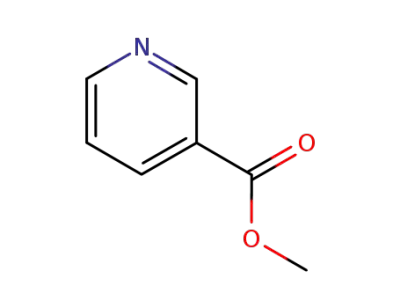
methyl 3-pyridinecarboxylate
-
614-18-6
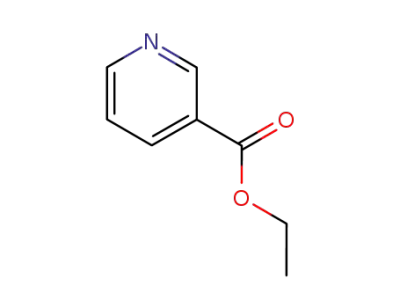
3-pyridinecarboxylic acid ethyl ester
100-55-0 Downstream products
-
100727-41-1
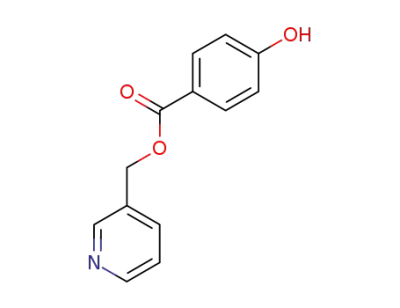
4-hydroxy-benzoic acid-[3]pyridylmethyl ester
-
132346-78-2

2,2-diphenyl-valeric acid-[3]pyridylmethyl ester
-
10072-09-0
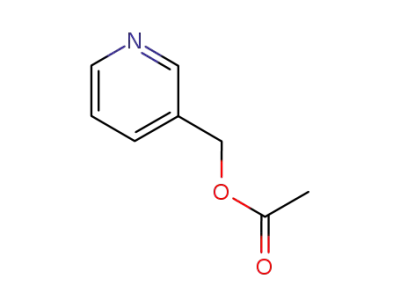
3-(acetoxymethyl)pyridine
-
59430-53-4
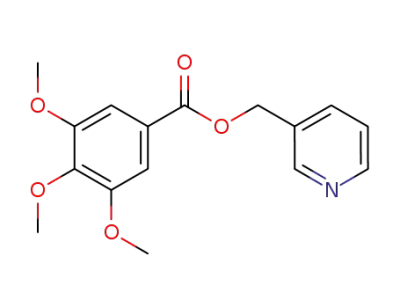
3,4,5-trimethoxy-benzoic acid-[3]pyridylmethyl ester
Related Products
-
-
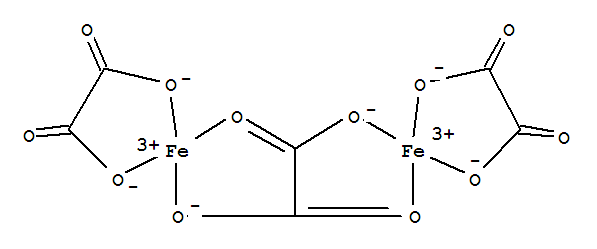 Ferric oxalate
CAS:2944-66-3
-
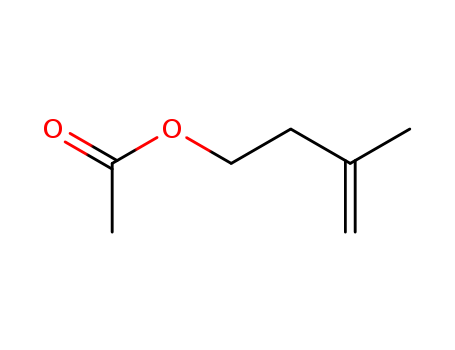 3-Buten-1-ol, 3-methyl-, acetate
CAS:5205-07-2